Naba Ahmed
January 15, 2026
You put in the hours. You research, you write, you edit, and you hit publish. Then… crickets. It’s a frustratingly common experience for many bloggers. The truth is, effort alone doesn’t guarantee results. The difference between a blog that gets ignored and one that drives traffic, builds authority, and attracts customers lies in the strategy behind the words. This is where a focused approach to blog content creation becomes your most powerful tool. This guide is designed to help you stop guessing and start building a blog that works for you. We’ll cover the essential steps for creating content that not only engages readers but also achieves your specific business goals, from optimizing for search to measuring your performance and making data-driven improvements.
Key takeaways
- Start with a clear strategy: The best content begins long before you write a word. Define your ideal reader, understand their needs, and set a specific goal for every post to ensure your work is focused and effective.
- Design for readability: Most people scan online content, so structure is key. Use clear subheadings, short paragraphs, and visuals to break up text and guide your reader, making your message easy to absorb even at a glance.
- Treat publishing as the starting line: Your work isn’t done when you hit publish. A great post needs a promotion plan to find its audience and analytics to measure its impact. Use this data to learn what resonates with your readers and refine your approach over time.
What is high-quality blog content?
Before we get into the nuts and bolts of content creation, let’s talk about what “high-quality” really means. It’s more than just perfect grammar or a high word count. A great blog post is like starting a conversation with your readers. It’s your chance to share ideas, tell stories, or offer genuinely helpful tips in a way that feels personal and approachable. The goal is to show there’s a real person behind the words, someone who understands the reader’s challenges and has something valuable to offer. High-quality content solves a problem, answers a question, or provides a new perspective that your audience can’t find anywhere else.
Just like a compelling presentation, a great blog post needs a solid foundation. The quality of your content determines whether someone clicks away after a few seconds or becomes a loyal reader who trusts your advice. It’s the difference between adding to the noise and creating a resource people will bookmark and share. As we learn how to build our content, we’ll focus on the principles that make a post not just good, but truly memorable and effective. This section will break down the essential elements that turn a simple article into a powerful piece of communication.

The core elements of a great post
Every great blog post has a clear reason to exist. If your post doesn’t have a central message or doesn’t “matter” to your readers, they simply won’t stick around. Think of it as the blueprint for your content. An effective post is built on a few key pillars: a clear purpose, an interesting headline that makes people want to click, and a logical structure that guides the reader smoothly from one point to the next. It also offers fresh ideas and is set up so people can easily find it online through search engines. Getting these core elements right is the first step to creating content that resonates with your audience.
What keeps readers engaged?
Facts and figures are important, but they don’t create a connection. What truly keeps readers engaged is your voice. The best advice is to write like you’re talking to a friend. Be authentic, share your opinions, and don’t be afraid to let your personality show through your words. This is how readers connect with you as a person, not just a brand. You can also make your points more relatable and memorable by using stories and examples. Instead of just listing facts, tell a compelling story from your own experience or share an anecdote that illustrates your message. This transforms a dry article into an engaging conversation.
How to spot high-quality content
High-quality content feels trustworthy from the first sentence. It’s clear, accurate, and shows that you are an expert in your field. You can build this credibility by always backing up your claims with facts, data, and links to reliable sources. When you state something as fact, make sure your information is detailed and correct. This isn’t just about avoiding errors; it’s about demonstrating respect for your reader’s time and intelligence. When someone reads your post, they should walk away feeling confident that they’ve learned something from a knowledgeable and reliable source. This is how you build an audience that not only reads your content but also trusts it.
Know your audience
Before you even think about a headline or an outline, you need to get crystal clear on one thing: who are you writing for? Creating content without a specific reader in mind is like giving a presentation to an empty room. You might have great ideas, but they won’t land if you’re speaking the wrong language or if no one is there to receive them. Taking the time to deeply understand your audience is the single most important step in creating content that not only gets read but also makes an impact. It’s the foundation for everything that follows.
Create your reader persona
Let’s get specific. A reader persona is a fictional character who represents your ideal reader. Giving this person a name, a job, and a set of goals makes them feel real and helps you write directly to them. What does their typical day look like? What challenges are they facing at work or in school? You can create customer profiles by looking at your existing customer data, sending out surveys, or even just interviewing a few people. For example, you might create “Marketing Manager Maria,” who needs to create compelling presentations for her team but is short on time. Every time you write, you’ll have Maria in mind.
Match content to your reader’s needs
Once you know your persona, your next step is to create content that genuinely helps them. Your blog isn’t just a place to talk about yourself; it’s a resource for your audience. Focus on what your reader needs, wants, and is interested in. Ask yourself: What problem does this post solve for Maria? Will it teach her a new skill, give her a fresh perspective, or provide a template that saves her time? Every piece of content should offer clear value. When you put your audience’s needs first, you build trust and establish yourself as a go-to expert in your field, making them more likely to return for more.
Decode search intent
Understanding your audience also means understanding how they search for information online. “Search intent” is simply the ‘why’ behind a person’s Google search. Are they looking for a quick answer, a detailed guide, or a specific product? To figure out what words people use, you can use keyword research tools, but also just common sense. Think about what Maria would type into the search bar. Is it “how to make a presentation interesting” (informational intent) or “best AI presentation software” (commercial intent)? Aligning your content with their search intent ensures that the people who need your help can actually find you.
Analyze how readers behave
Getting to know your audience is an ongoing conversation, not a one-time task. Once you’ve published your content, pay attention to how people react to it. Tools like Google Analytics can show you which posts are the most popular, how long people are staying on the page, and where your traffic is coming from. This data is pure gold. If you notice that posts with video tutorials get a lot of engagement, make more of them! According to the 80/20 rule, a small percentage of your content will likely drive most of your results. Find out what that is and lean into it.
Plan your content strategy
You wouldn’t walk into a big presentation without a plan, right? You’d have your key points, your visuals, and a clear idea of what you want your audience to take away. Think of your blog’s content strategy as the same kind of roadmap.
A solid strategy ensures every post you publish has a purpose. It helps you stay consistent, build trust with your audience, and work toward your bigger business goals, whether that’s attracting new customers or establishing yourself as an expert. Without a plan, you’re just guessing. With one, you’re building a valuable asset for your brand, one thoughtful post at a time. This plan doesn’t have to be a hundred-page document; it’s about making intentional choices about what you’ll create and why.

Set clear content goals
Before you can map out your journey, you need to know your destination. Every blog post you write should have a clear goal that supports your overall strategy. What do you want each piece of content to do? Are you trying to attract first-time visitors to your site? Maybe you want to capture email addresses for your newsletter, or perhaps you’re aiming to educate existing customers on how to use your product better. As the experts at ProBlogger say, “Every post needs a reason to exist.” Defining this reason upfront helps you focus your writing and measure your success later. Pick one or two primary goals for your blog—like building brand awareness or generating leads—and make sure every topic you choose aligns with them.
Build your content calendar
A content calendar is your best friend for staying organized and consistent. It’s essentially a schedule of when you’ll publish your upcoming blog posts. This simple tool takes the guesswork out of what to write next and prevents that last-minute panic. You can use a basic spreadsheet, a Trello board, or even Google Calendar to plan your content weeks or months in advance. A good content calendar helps you map out topics, align posts with holidays or product launches, and ensure a steady flow of fresh content for your readers. It’s the key to maintaining a consistent brand voice and publishing schedule, which builds anticipation and trust with your audience over time.
Choose topics your audience cares about
The most successful blogs are the ones that consistently solve their readers’ problems. To do that, you have to know what those problems are. This is where your reader persona comes in handy. Think about their biggest challenges, their goals, and the questions they’re constantly asking. Where do you find these ideas? Listen to the questions your sales team gets, browse forums like Reddit and Quora in your niche, and see what topics your competitors are covering. Your goal is to create content that feels like it was written specifically for them. When you understand who you’re writing for, you can create genuinely useful and interesting posts that they’ll want to read and share.
How to do keyword research
Keyword research is how you discover the specific words and phrases your audience is typing into Google. It’s a critical step for making sure your content gets found. The idea is to find topics that people are searching for (search volume) but that don’t have a ton of other websites already writing about them (competition). You can use tools like Google Keyword Planner or Ahrefs to get started. Begin with a broad “seed” keyword related to your business—like “presentation tips”—and see what related phrases pop up. Look for longer, more specific phrases (known as long-tail keywords), as they often have less competition and attract a more targeted reader. This process connects your great ideas with the people actively looking for them.
Pick the right format for your content
Not all topics should be presented in the same way. The format of your blog post should match the subject matter and what your reader is looking for. Are you teaching someone a new skill? A step-by-step “how-to” guide with screenshots would be perfect. Are you sharing a list of resources or ideas? A listicle (like “10 Ways to Make Your Presentation More Engaging”) is easy to scan and digest. Other popular formats include case studies, expert interviews, checklists, and trend reports. By choosing the right content format, you make your information more accessible and useful, which keeps readers on your page longer. Don’t be afraid to mix things up to keep your blog dynamic and interesting.
Write compelling headlines and introductions
Your headline and introduction are the gatekeepers of your content. A great headline earns the click, and a compelling introduction convinces the reader to stay. If you get these two elements right, you’ve won half the battle. They work together to make a promise to your audience: “This is worth your time.” Think of them as the opening scene of your presentation—they need to be sharp, engaging, and set the stage for everything that follows.

Formulas for catchy headlines
You don’t have to reinvent the wheel every time you write a headline. Proven formulas can give you a great starting point. Try using numbers, especially odd ones, to make your title feel specific and actionable, like “7 Ways to Make Your Presentation More Interactive.” Asking a question can also pull readers in by making them curious about the answer. Remember to include your main keyword to help search engines understand your topic, and keep your headline under 70 characters so it displays properly in search results. You can also use brackets for extra clarity, like “[With Examples].” These simple structures provide a reliable framework for creating titles that get noticed.
Use words that grab attention
Vague headlines get ignored. Your goal is to be specific and promise value. Instead of a generic title like “Tips for Public Speaking,” try something more descriptive: “10 Public Speaking Tips to Calm Your Nerves and Engage Any Audience.” The second option tells the reader exactly what they’ll get. Use strong, active verbs and descriptive adjectives that create a clear picture. The key is to be interesting without being misleading. Your headline should accurately reflect the content of your post while making it sound like a must-read. This approach builds trust and encourages people to explore your ideas.
Write an introduction with a purpose
Once someone clicks your headline, the first few sentences determine if they’ll stick around. Your introduction needs a clear purpose: to hook the reader and explain why your post matters to them. Don’t waste time with fluffy lead-ins. Get straight to the point and tell your audience what problem you’re going to solve or what information you’re going to provide. Every post needs a reason to exist, and your intro is where you state that reason. If you can’t articulate why your post is valuable in the first paragraph, your reader will likely move on to something else.
Craft a hook that works
The very first sentence of your introduction is your hook. Its only job is to get the second sentence read. You can start with a surprising statistic, a relatable anecdote, a thought-provoking question, or a powerful quote. For example, you could open with, “Did you know that 75% of people have a fear of public speaking?” This immediately connects with a common pain point. Whatever hook you choose, make sure it transitions smoothly into the main topic of your post. A great hook grabs attention and sets a clear path for the reader, making them eager to build on the knowledge you’re about to share.
Structure your post for easy reading
Think about the last time you landed on a blog post that was just a massive wall of text. Did you stick around to read it? Probably not. The reality is, most people don’t read online content word-for-word; they scan. Your job as a writer is to make that scanning process as easy and rewarding as possible. A well-structured post guides your reader’s eye, helps them find the information they’re looking for, and makes your message much more likely to stick.
Structuring your post isn’t about dumbing down your content. It’s about respecting your reader’s time and attention. By using clear headings, short paragraphs, engaging visuals, and credible data, you create a reading experience that feels effortless and valuable. This framework not only keeps people on your page longer but also helps them absorb your key points. Think of it as building a clear path through a forest of information—you’re the guide, and these structural elements are your signposts. Let’s walk through how to build a post that’s as easy to read as it is informative.
Use smart subheadings
Subheadings are the roadmap for your blog post. They break up long stretches of text and signal to the reader what’s coming next, making your content much easier to follow. When a reader can glance at your subheadings and get a solid idea of what your article covers, they’re more likely to invest their time in reading it. Use headings to create a logical flow and a clear hierarchy (H2s for main sections, H3s for subsections). Make them descriptive and compelling—ask a question, promise a benefit, or create curiosity. This simple practice transforms a daunting block of text into an inviting, organized piece that keeps your reader engaged from start to finish.
Make your content scannable
Since we know readers scan, your goal is to make your key points jump off the page. Keep your paragraphs short and focused, ideally no more than three to four sentences each. This creates white space that gives your content room to breathe and makes it feel less intimidating. Use formatting tools to your advantage. Bullet points are perfect for lists, while bold text can emphasize important terms or takeaways. This approach allows readers to quickly absorb the main ideas even if they’re just skimming, which greatly improves their experience and comprehension. It’s a simple way to ensure your message gets across effectively.
Add engaging visuals
Visuals are essential for breaking up text and making your content more dynamic and memorable. A great image, infographic, or chart can often explain a complex idea more effectively than words alone. As the team at Wix notes, “Pictures, graphs, or custom art make your post more lively and keep readers interested.” When you’re creating a presentation, you wouldn’t just use text, and the same principle applies to your blog. You can even embed a short Prezi Video to speak directly to your audience. Just be sure to choose high-quality visuals that are directly relevant to your content and add real value for the reader.
Back up claims with data
Want to build trust with your audience? Back up your statements with evidence. Citing facts, data, and reliable sources shows that you’ve done your research and adds a layer of credibility to your writing. It’s important to “back up your claims with facts, data, and reliable sources.” Instead of just saying something is “popular,” find a statistic that proves it. Linking to original studies or expert opinions not only strengthens your argument but also provides a valuable resource for readers who want to learn more. This practice positions you as a trustworthy authority in your field.
Write a clear call to action
Every blog post should have a purpose, and your call to action (CTA) is what guides your reader toward that goal. After you’ve provided value and information, what do you want them to do next? A clear CTA answers that question. It could be a simple invitation to leave a comment, subscribe to your newsletter, or read a related article. Use direct, action-oriented language like “Download the template” or “Start your free trial.” This final instruction is crucial for turning a passive reader into an active member of your community or a potential customer. It gives your content a clear and effective conclusion.
Refine your writing process
Once you’ve planned your content and structured your post, the real writing begins. This is where you transform your research and ideas into a piece that connects with your audience. It’s more than just filling in the blanks of your outline; it’s about breathing life into your words and making sure your message is heard loud and clear. A refined writing process ensures your final draft is clear, engaging, and polished. It’s the difference between a post that gets skimmed and one that gets read, shared, and remembered.
Think of it like preparing for a big presentation. You wouldn’t just throw your slides together at the last minute. You’d carefully craft each point, practice your delivery, and make sure your message lands perfectly. The same care should go into your writing. This stage is all about craftsmanship. It involves finding the right words to express your ideas, structuring your sentences for maximum impact, and telling a story that pulls your reader in. It also means being your own toughest critic, ready to cut what doesn’t work and polish what does. By focusing on your voice, storytelling, readability, and editing, you can create content that not only informs but also inspires action. Let’s walk through the key steps to sharpen your writing and make every post shine.
Find your unique voice
Your voice is your personality on the page, and it’s what makes readers feel like they know you. Don’t try to sound like a textbook or a corporate robot. Instead, write like you’re talking to a friend over coffee. Be authentic, share your honest opinions, and let your unique perspective shine through. This is how you build a genuine connection and earn your readers’ trust. When your voice is consistent and true to you, people will remember your content and keep coming back for more. A great way to check if you’re on the right track is to read your writing out loud. Does it sound like something you’d actually say? If not, it’s time for a rewrite.
Tell a compelling story
Facts and figures can inform, but stories are what make your message stick. We’re all wired to connect with narratives. Instead of just listing data points, weave them into a compelling story. Share a personal experience, a customer success story, or a relatable example to illustrate your points. This makes abstract ideas feel concrete and helps your audience see why your topic matters on a human level. Great storytelling doesn’t just make your content more memorable; it creates an emotional connection that can persuade and inspire your audience. Think about the last presentation or article that truly moved you—chances are, it told a great story. Aim to do the same with your blog posts.
Keep your writing easy to read
Online readers have short attention spans. If your post is a giant wall of text, they’ll likely click away before they even start. Make your content easy to scan and digest by breaking it up. Use short paragraphs—no more than three or four sentences each. Guide your reader through the post with clear headings and subheadings. Use bullet points and numbered lists to present information in a structured way. This isn’t about “dumbing down” your content; it’s about respecting your reader’s time and making your valuable information as accessible as possible. Good visual design isn’t just for presentations; it’s crucial for creating a positive reading experience on your blog, too.
Use tools for grammar and style
Even the most experienced writers make mistakes. Small typos or grammatical errors can distract your readers and damage your credibility. Luckily, there are plenty of tools available to help you catch these slip-ups before you hit publish. Services like Grammarly can check your spelling and grammar, but they also offer suggestions to improve your style and clarity. They can help you spot passive voice, repetitive words, and overly complex sentences. Using these tools isn’t a sign of weakness; it’s a smart way to ensure your writing is as professional and polished as possible. Think of them as a friendly editor looking over your shoulder, helping you put your best work forward.
Edit and proofread like a pro
Writing and editing are two different skills that require two different mindsets. Don’t try to do both at the same time. Once you’ve finished your first draft, step away from it for a while—at least a few hours, or even a full day. When you return with fresh eyes, you’ll be much better at spotting awkward phrasing, logical gaps, and areas that need more clarity. This is the editing phase, where you focus on the big picture. After you’ve edited, it’s time for the final proofread. Read your post out loud to catch typos and grammatical errors your eyes might have skipped over. This final polish is what separates good content from great content.
Using AI presentation tools for blog content creation
Blog content creation often breaks down at the same point: turning a good idea into a clear, well-structured post. Many bloggers don’t struggle with what to say—they struggle with how to organize it.
This is where AI presentation tools have become unexpectedly valuable for bloggers.
At their core, these tools are designed to help people structure ideas, prioritize key points, and guide an audience through information in a logical way. When applied to blogging, that same capability becomes a powerful planning and clarity tool—not just a design feature.
Instead of starting with a blank document, AI presentation tools allow you to begin with a high-level content framework. By entering a topic and brief description, the AI can generate grouped sections and supporting points that function like a strategic outline for your post.
For bloggers, this approach helps:
- Eliminate the blank-page problem
- Create a clearer section hierarchy
- Spot missing or redundant ideas early
- Write with flow instead of forcing it later
The result is content that feels intentional, focused, and easier to read. Which is the case Blog for Ben makes.
He shares how he uses Prezi AI to create compelling presentations that are great for bloggers, content creators, and entrepreneurs.
Designing content around how people actually consume it
Most readers don’t read blog posts line by line. They scan, jump between sections, and focus on what’s most relevant to them.
AI presentation tools naturally encourage this kind of thinking by organizing content into topic-based clusters rather than long, linear text. Each section is treated as a standalone idea that connects to the bigger picture.
When you use this mindset for blogging, you naturally:
- Write tighter sections
- Use clearer subheadings
- Improve scannability and comprehension
- Create content that holds attention longer
If an idea doesn’t stand on its own in a presentation-style format, it usually needs refinement in the blog as well.
How Prezi AI fits into this workflow
Prezi AI is a strong example of how AI presentation tools can support blog content creation—because it focuses on structure and clarity before design.
With Prezi AI, you start by entering a blog topic and a short explanation of what the content should cover. From there, the AI generates a presentation organized into main topics and subtopics.
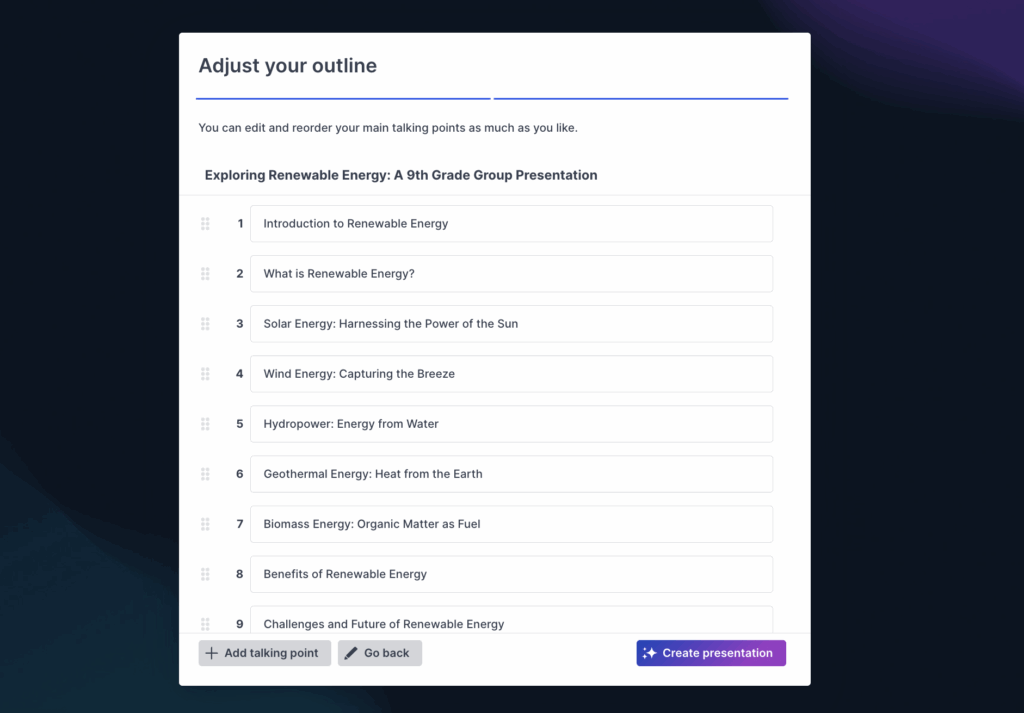
For bloggers, these map directly to:
- Blog sections (H2s)
- Supporting points (H3s)
- Logical content flow
This makes Prezi AI especially useful at the planning stage. Before writing a single paragraph, you can:
- Review your entire post structure at a glance
- Rearrange sections to improve flow
- Identify weak or unnecessary sections
- Ensure your content supports a clear goal
From outline to blog draft (without extra work)
Once your structure is set, the Prezi AI framework becomes your writing guide. Each topic turns into a focused section of your post, helping you stay on track and avoid overexplaining or drifting off-topic.
Prezi AI’s editing features can also help refine content along the way by:
- Simplifying complex explanations
- Turning long text into clearer bullet points
- Expanding sections that feel underdeveloped
You’re still in control of the voice and expertise—but the AI helps remove friction from the process.
Built-in repurposing for content promotion
One of the biggest advantages of using Prezi AI is what happens after the blog post is published.
The same structure used to plan your blog can easily be reused to:
- Create a visual summary of the post
- Build a presentation for LinkedIn or webinars
- Record a short video walkthrough
- Add visual takeaways directly into the article
Instead of creating new assets from scratch, you’re extending the life of a single idea across multiple formats—saving time while increasing reach.
Using AI without losing your voice
Prezi AI doesn’t replace your thinking. It supports it.
The goal isn’t to let AI write for you, but to let it:
- Accelerate planning
- Improve structure
- Clarify messaging
- Reduce unnecessary rewrites
When AI presentation tools are used this way, they help bloggers focus less on formatting and more on creating content that genuinely serves their audience.
At the end of the day, successful blog content isn’t about writing more—it’s about writing with intention. When you combine a clear strategy, a deep understanding of your audience, strong structure, and the smart use of tools like AI presentation software, blogging stops feeling like guesswork and starts feeling repeatable. Whether you’re outlining posts, improving clarity, or repurposing ideas across formats, the goal stays the same: guide your reader through your ideas in a way that’s easy to follow and genuinely helpful. When you approach blog content the way you’d approach a great presentation—with focus, flow, and purpose—you give your work the best chance to be seen, trusted, and acted on. Try Prezi AI to accelerate the time it takes to create your next blog post.
Frequently Asked Questions
SEO feels overwhelming. What’s the most important thing to focus on when I’m just starting? Don’t get bogged down by all the technical jargon. The single most important thing you can do for SEO is to write the best, most helpful answer to a question your audience is asking. Think about what problem you’re solving for your reader and focus on creating a clear, comprehensive, and easy-to-read post about it. When you prioritize helping a real person, you’re naturally doing most of what search engines want to see.
How do I find my unique writing ‘voice’? Your writing voice is really just your personality translated into words. The best way to find it is to stop trying to sound like a “writer” and start writing the way you actually talk. A great trick is to read your draft out loud. If it sounds stiff, formal, or like something you’d never say in a real conversation, rewrite it until it sounds like you. Your voice will develop naturally the more you write with authenticity.
How often should I be publishing new blog posts? There’s no magic number here. What matters far more than frequency is consistency. It’s much better to publish one high-quality, well-researched post every week than to publish five mediocre ones. Look at your resources and create a realistic schedule you can stick to over the long term. Your audience will learn to trust and anticipate your content when you show up for them on a predictable basis.
What’s the best way to come up with blog post ideas my audience will actually care about? The best ideas come from listening. Pay attention to the questions your customers ask your sales or support teams. Browse online forums like Reddit or Quora to see what challenges people in your industry are discussing. Your goal is to find the real-world problems and curiosities your audience has and then create content that directly addresses them. When you solve a genuine problem, your content will always be valuable.
Is it better to write a really long, detailed post or several shorter ones? This depends entirely on the topic and what your reader needs. For a complex subject, a long, in-depth guide that covers everything in one place is incredibly valuable. For a quick tip or a simple list, a shorter post is more appropriate. Instead of aiming for a specific word count, aim to be as thorough as the topic requires. The right length is whatever it takes to fully answer your reader’s question without adding unnecessary fluff.
How can an AI presentation tool help me write better blog posts? AI presentation tools can turn a rough idea into a structured outline (topics + subtopics), which makes it easier to plan your sections, headings, and flow before you draft.